


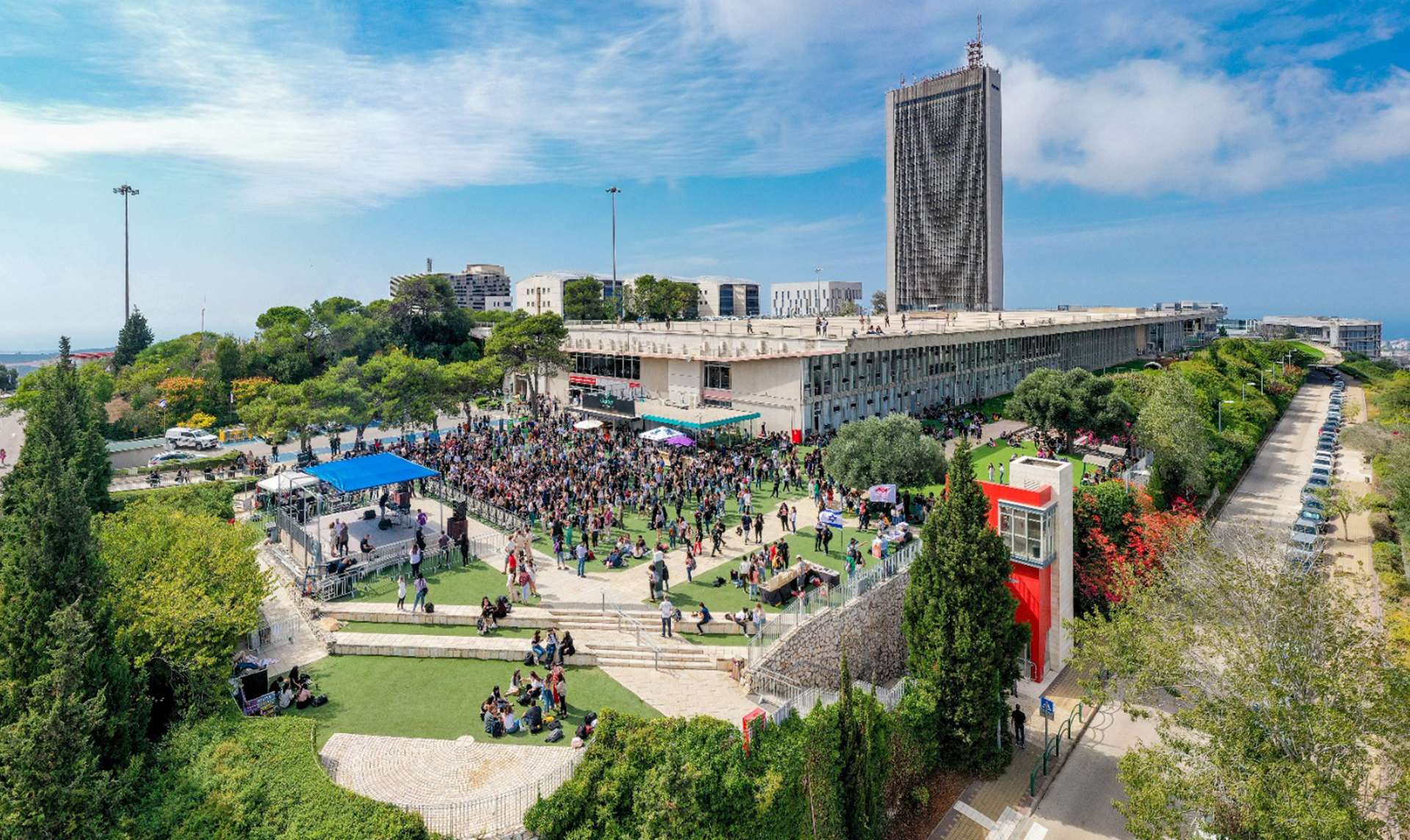
The University of Haifa’s International MA Program in Hebrew Language, specialized in the field of the Hebrew Bible trains students to read and academically analyze the ancient texts of the Bible, which stand at the heart of Judaism and Christianity. It is taught in English by the Department of Hebrew Language in the Faculty of Humanities and is headed by Dr. Ohad Cohen. The curriculum combines Biblical Hebrew, Aramaic, and Koine Greek with biblical interpretation, archaeology, and the history and culture of ancient Israel and the ancient Near East. The program is taught in collaboration with the Israel Institute of Biblical Studies, which has taught more than 110,000 students worldwide. Classes are held online at hours that serve every time zone.
The non-thesis track is completed in two academic years, each divided into three semesters and running from October to September. Asynchronous courses are open throughout the year, and synchronous classes are offered at both flexible and fixed times. Students also complete three Modern Hebrew courses, at basic, intermediate and advanced level, at any stage of their studies. Graduates are awarded a Master of Arts (MA) in Hebrew Language, specialized in the field of the Hebrew Bible.
Students who choose the research track attend an additional summer semester at the University of Haifa and devote a third year to a seminar and to supervised thesis research.

Introduction to the Hebrew Bible World
Biblical Hebrew from a Literary View: Prose, Poetry, Legal Texts, Prophecy and Wisdom Literature
Biblical Aramaic from a Comparative Perspective
Biblical Texts: Leviticus
Biblical Hebrew: Advanced Issues in Syntax and Morphology
Biblical Hebrew in Historical Perspective: From Proto-Semitic to the Dead Sea Scrolls
Ugarit: Language and Culture
Isaiah in Historical Reality
The Age of Empires: The Land of Israel under Assyrian, Babylonian and Persian Domination
Biblical Archaeology in Israel (summer tour, research track)
* The curriculum is subject to change without notice
Applicants who are not native English speakers and who have not completed a previous degree at an institution where English was the language of instruction will be required to submit official proof of English proficiency (TOEFL iBT 85 or equivalent).
Previous knowledge of Modern Hebrew, Biblical Hebrew, Aramaic, or related languages will be assessed during admission and placement. Applicants who lack part of the required preparation may be assigned prerequisite or complementary courses.
Applicants will generally be asked to submit:
The program offers attractive scholarships for eligible students.
Click here to learn about additional scholarship opportunities
Yes. The two-year non-thesis track is completed entirely online and requires no attendance in Israel.
Yes. The three-year research track includes two years of online coursework, a concentrated summer term at the University of Haifa, and a third year devoted to supervised thesis research.
Applicants may enter with different levels of Hebrew and other relevant languages. Previous study will be assessed, and prerequisite or complementary language courses may be required. Admission to advanced courses depends on achieving the necessary level.
Degree courses are taught in English. Hebrew, Aramaic, and other languages are studied as subjects and used in the analysis of primary texts.
The program includes live online classes and selected asynchronous components. Institute language courses offer several scheduling possibilities, while University of Haifa seminars meet at fixed weekly times. Detailed schedules are published for each academic term.
The research track is designed for students who wish to pursue further academic research, including potential doctoral studies.
Graduates receive a Master of Arts in Hebrew Language from the University of Haifa, specialized in the field of the Hebrew Bible.


